
The security of nearly all Python applications depends on two critical factors:
The development and maintenance processes used.
The quality and security of the dependencies they rely upon.
One of the fastest and most effective ways to assess dependency risk is through Google Open Source Insights (commonly known as deps.dev).
What is Open Source Insights?
Open Source Insights is a free public service developed and maintained by Google. It analyses open source packages across multiple ecosystems, builds complete dependency graphs, and surfaces rich security, licensing, and maintenance information.
Unlike many dependency scanners that only check direct dependencies listed in your pyproject.toml or requirements.txt, Open Source Insights provides a full transitive view of your dependency tree. It draws on high-quality data from OSV (Open Source Vulnerabilities) and other sources, giving you a much more complete picture.
Key Features
Interactive dependency graphs showing both direct and transitive dependencies
Support for multiple ecosystems (Python, npm, Go, Maven, Cargo, etc.)
Rich metadata including:
Known vulnerabilities (via OSV)
OpenSSF Scorecards (where available)
Licence information
Project popularity and ownership details
Daily updates
Free public web interface with no installation required
BigQuery dataset available for advanced analysis
Valuable Insights for Python Projects
When you look up a package, Open Source Insights provides several key pieces of information:
OpenSSF Scorecard
Where available, this gives an objective assessment of the project’s security practices (e.g. use of CI/CD, code review, vulnerability disclosure, etc.). Note that many smaller projects do not have a Scorecard.
All Dependencies
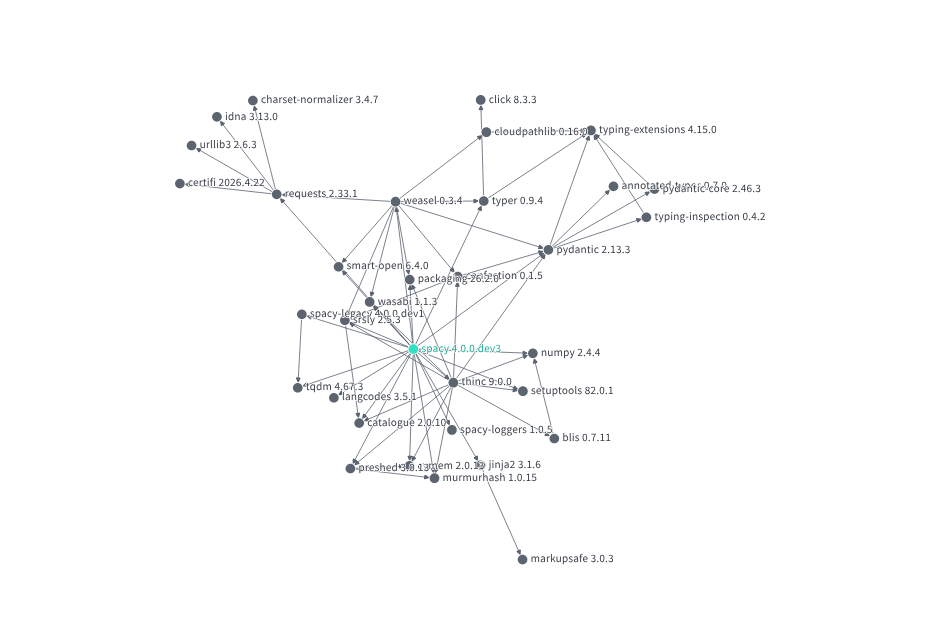
You can explore both direct and indirect (transitive) dependencies in a clear table or through an intuitive visual graph. This is particularly useful for understanding the true attack surface of your project.
Note
Dependency definition
A dependency is any external package required for your code to function.
Direct dependencies: explicitly declared in your project.
Indirect (transitive) dependencies: pulled in automatically by your direct dependencies.
Open Source Insights excels at visualising the full dependency graph.
Example: Dependency graph for spaCy
All Dependents
This shows how many other packages rely on a given library — a strong indicator of its importance in the Python ecosystem.
Note
Dependents definition
A dependent is the inverse of a dependency. Packages with many dependents are often critical infrastructure. A vulnerability in such a package can have widespread impact.
Security Advisories
Any known vulnerabilities are clearly listed, with links to detailed advisories.
Understanding both your dependencies and their transitive relationships is essential. Many serious supply chain attacks exploit indirect dependencies that teams are unaware they are using.