
What is Static Application Security Testing (SAST)?
Static security testing, also known as Static Application Security Testing (SAST),is a security methodology that analyzes an application’s source code and related artifacts (such as design documents) without executing the code. The purpose is to identify potential security weaknesses before developing or running the application.
For Python applications, specific Python SAST tools perform an in-depth, automated review of the source code to detect security weaknesses and potential vulnerabilities early in the development lifecycle.
SAST testing is a “white-box” testing approach because it analyzes the application’s internal structure, typically by examining the code directly. Dynamic application testing is more complex and often only sensible within the target context where an application will run! For dynamic application testing so called fuzzers are used.
How SAST works on Python Code
The primary advantage of SAST for Python is automation. SAST tools automatically scan the code’s structure, data flow, and control flow without executing the code. The characteristics of transparent open Python SAST tools are:
Objective: The specific function calls that can lead to security problems are transparent. So it is completely transparent what rules are used to check the Python code on weaknesses. Mind that when a property and/or AI solution is used it is often completely unknown what rules are used. And the bad news is: Most commercial tools have a very limited set of rules!
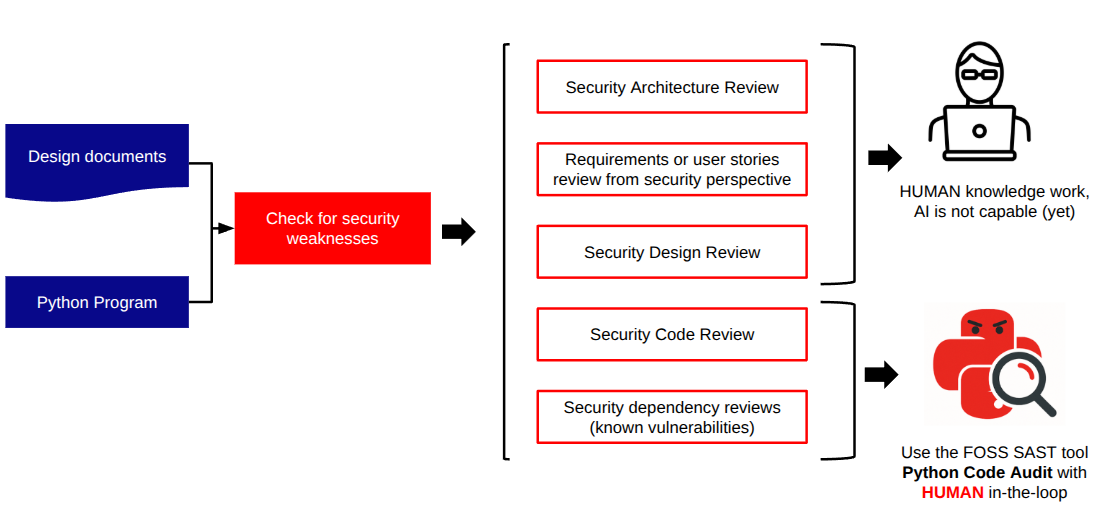
Human Role: While scanning is automated, human intelligence is crucial for reviewing the findings. A human developer or security analyst must determine the context where the program will be used and decide if the vulnerability requires fixing.
Limitation: No single tool, even one powered by AI, can definitively know the exact environment or business context in which the Python code runs. Therefore, fully automating the fix process is generally undesirable. While AI can suggest and even generate fixes, only a human developer or security professional can accurately weigh the development costs against the actual security risks and confirm that the change won’t introduce new functional bugs or operational failures.
Why Static Application Security Testing on Python Code
Static Application Security Testing (SAST) is crucial for securing Python applications. SAST testing helps proactively identify vulnerabilities directly in the source code.
Python Static Application Security Testing (SAST) offers significant advantages by analyzing source code directly.
Advantages of Security Testing(SAST) on Python code
| Benefit | Description |
|---|---|
| Shift Security Left ⚙️ | Catches vulnerabilities early in the Software Development Lifecycle (SDLC). |
| Save Time and Cost 💰 | Fixing flaws during the coding phase is far cheaper and faster than costly post-release patches or emergency fixes in production. |
| Automate Checks 🤖 | SAST is easily integrated into CI/CD pipelines to automatically validate the security of new code changes, ensuring continuous security. |
| No Runtime Needed 🔎 | The source code is analyzed without execution, eliminating the risk of running potentially malicious or flawed code during the test. |
| Reduce Attack Surface 🛡️ | Systematically identifies and helps eliminate exploitable code paths, significantly reducing the vulnerability surface that hackers can target. |
| Improve Code Quality ✨ | Encourages developers to adhere to secure coding standards. |
| Support Compliance 📜 | Simplifies alignment with mandatory security rules and regulations, such as PCI DSS, HIPAA, and ISO standards, by providing documented evidence of security testing. |
| Actionable Reporting 📝 | Generates clear, developer-friendly reports that pinpoint the exact location of the possible issue and include remediation guidance. |
| Build Customer Trust ⭐ | Releasing applications with rigorously tested security leads to stronger reliability and greater confidence from users and stakeholders. |
Risks of Skipping security testing(SAST) on Python code
| ✔️ Advantages with SAST | ❌ Risks Without SAST |
|---|---|
| Catch vulnerabilities early in development | Security flaws discovered only after deployment |
| Save time & reduce remediation costs | Fixing issues post-release is expensive and disruptive |
| Shift security left in the SDLC | Security treated as an afterthought |
| Improve code quality with secure standards | Codebase grows with technical debt |
| Automate checks and scans | Manual reviews are inconsistent and time-consuming. Only vulnerabilities that are known by the reviewer are taken into account. However, the number of possible vulnerabilities is large and continuously growing. |
| Detect a wide range of vulnerabilities | Many risks remain invisible until exploited. |
| Python-specific analysis for accuracy | Generic tools miss Python idioms and constructs |
| No runtime required for scanning | Vulnerabilities appear only during execution |
| Easy for CI/CD pipeline integration | Security slows down release cycles |
| Consistent enforcement of policies | Developers apply ad-hoc, inconsistent practices |
| Easier compliance support | Increased risk of regulatory non-compliance |
| Reduce attack surface proactively | Hackers exploit weak, untested code |
| Teach secure coding practices | Knowledge gaps persist in the team |
| Streamline penetration testing efforts | Pen testers waste time on basic issues |
| Reduce technical debt | Complexity and vulnerabilities pile up |
| Build customer trust & confidence | Loss of reputation and user trust after breaches |
While Python is often considered a secure language, also Python applications are susceptible to common security flaws, and SAST is a crucial, cost-effective method to address them before deployment.
Python is one of the most used programming language to date. Especially in the AI/ML world and the cyber security world, most tools are based on Python programs.
Large and small businesses use and trust Python to run their business. Python is from security perspective a good choice. However even when using Python the risk on security issues is never zero.
When creating solutions practicing Security-By-Design to prevent security issues is too often not the standard way-of-working.
When you create software that in potential will be used by others you MUST take security into account.
Python Code Audit is designed for Python codebases. It is tailored to Python’s syntax and unique constructs, enabling it to identify potential security issues effectively.
Python Code Audit SAST tool is an advanced security solution that automates the review of Python source code to identify potential security vulnerabilities.
At a function level, Python Code Audit makes use of a common technique to scan the Python source files by making use of ‘Abstract Syntax Tree(AST)’ to do in-depth checks on possible vulnerable constructs.
Simple good cyber security is possible by Shift left. By detecting issues early in the SLDC process the cost to solve potential security issues is low.
Difference Between Weakness and Vulnerability
Every Python SAST tool — including Python Code Audit — scans your codebase for potential security issues. These tools flag weaknesses that could lead to exploitable security vulnerabilities.
Understanding the distinction between a weakness and a vulnerability is essential for effective security decision-making.
Definitions
To use a Python SAST scanner effectively, it is vital to understand the difference between a weakness and a vulnerability:
Weakness (or potential security issue):
A weakness is a flaw, error, poor design choice, or unsafe programming practice in your code that might create security problems under certain conditions. It represents an increased risk, but it is not necessarily exploitable in your specific context.
Weaknesses do not create or lead to threats; rather, they act as an open door for existing threats.
Examples in Python:
Using
eval()on user input. This is a weakness because it allows arbitrary code execution if misused.Hardcoding credentials in code (e.g.
password = "admin123") This is a weakness because it exposes sensitive data.
Vulnerability:
A vulnerability is a weakness that could be exploited by an attacker to compromise the confidentiality, integrity, or availability of your system.
A vulnerability can be targeted intentionally by an attacker or triggered incidentally by a user or administrator (e.g. to execute malware, escalate privileges, leak data accidentally, or make the system unavailable).
Key Rule: All vulnerabilities are weaknesses, but not all weaknesses are vulnerabilities.
Example:
A developer introduces a Weakness (e.g., forgets to sanitize inputs).
Because this code is deployed in a live environment, it becomes a Vulnerability (an open door).
A Threat (the hacker) discovers the vulnerability and exploits it.
This results in a Security Incident or breach. But this security incident can be prevented when using a Python SAST tool before deployment.
Why This Distinction Matters
Not every issue reported by a SAST tool needs urgent fixing. However, every weakness should be evaluated rather than ignored. Treating weaknesses seriously significantly reduces the likelihood of exploitable vulnerabilities appearing later.
Common Weaknesses Found by Python Code Audit
Here are some typical categories of weaknesses that static analysis tools often detect in Python projects:
Code Execution Risks
Use of dangerous functions such aseval(),exec(), orcompile()that can execute untrusted code.Permission and Access Control Issues
Setting overly permissive file or directory permissions (e.g.,chmod(0o777)), which can lead to data leakage or unauthorised modification.Input Handling Problems
Missing validation, improper sanitisation, or dangerous deserialisation.Cryptographic Weaknesses
Use of outdated algorithms, weak random number generation, or improper key management.
Best Practice Recommendation
High-severity or clearly exploitable findings → Fix immediately.
Medium or context-dependent weaknesses → Evaluate based on your threat model, deployment environment, and data sensitivity.
Low-risk issues → At minimum, acknowledge them and consider fixing during refactoring.
Document your decisions for security-relevant findings. This creates an audit trail and helps the team develop better security awareness over time.
Specialized Python SAST Scanners
Effective Python SAST scanners identify weaknesses in Python code by monitoring the use of Python library calls known to lead to vulnerabilities. Unfortunately, many scanners only implement a very limited selection of potential weaknesses within the Python Standard Library (PSL) modules.
Examples:
A Python application using
eval(input())where an attacker can inject Python code to run arbitrary commands.The weakness (
evaluse) has become a vulnerability because it’s exploitable.Using
assertstatements in production code. The weakness (assertuse) can become a vulnerability becauseassertstatements can be disabled during runtime.
| Concept | Definition | Exploitability | Example |
|---|---|---|---|
| Weakness | Flaw that could lead to a security issue | Not necessarily exploitable | Using eval() on untrusted input |
| Vulnerability | A weakness that can be exploited | Exploitable | Attacker injects malicious code via eval(input()) |