
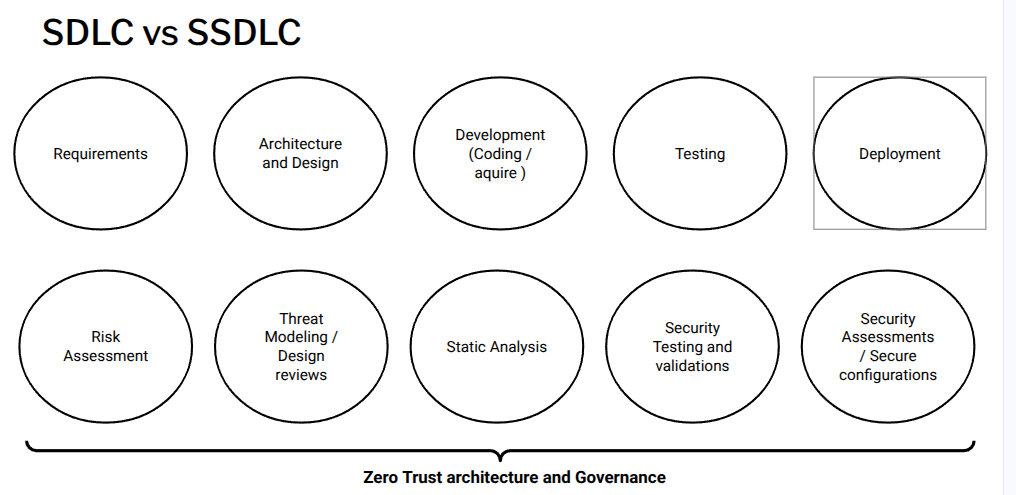
The diagram compares a traditional Software Development Life Cycle (SDLC) with a Secure Software Development Life Cycle (SSDLC). Its main message is simple: security must be built into every stage, not added at the end.
The top row shows the usual development steps: Requirements, Architecture and Design, Development, Testing, and Deployment. These represent how software is typically planned, built, and released.
The bottom row shows the security activities that should happen alongside each step:
In Requirements, carry out a risk assessment to identify threats early.
In Design, use threat modelling and design reviews to prevent weaknesses in the architecture.
In Development, apply static analysis to find vulnerabilities in the code.
In Testing, perform security testing to ensure the system behaves safely under attack.
In Deployment, complete security checks and apply secure configurations before release.
Across all stages, Zero Trust principles and all Security By Design principles MUST apply, so:
Assume systems may already be compromised, verify every access request, and give only the minimum access required.