
To create a sustainable solution to reduce cyber security threats is to create a solution architecture. Within this architecture you design a solution that meets your functional requirements. But this architecture is also to match design the protection measurements needed based on your risk analysis.
The perfect solution to reduce security risks to zero does not exist. A security architecture assists in the process of optimising and managing your risks.
A good way to really speed up creating your solution architecture is of course to use this reference architecture as the basis.
A Security Architecture describes how security measurements are positioned. Measurements can be process related or be implemented by a security product such as a SIEM system.
Security Architecture: The Bridge Between “What” and “How”
Security Architecture lives in the tension between what we need to achieve and how we will actually achieve it. Security Architecture is the complex field between what and how.
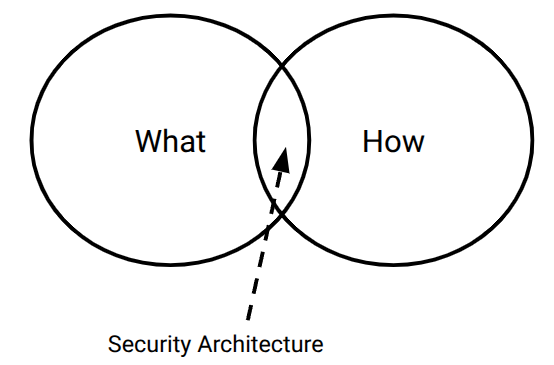
Most architects and consultants focus almost exclusively on the what—the policies, controls, and compliance requirements. But architects who truly practice Security By Design never lose sight of the how.
Why? Because the how is what makes or breaks a secure architecture.
If a security control cannot be implemented simply, it will:
Be misconfigured
Be bypassed
Be abandoned
And that means security is not helped—it is harmed.
The aims of a good and simple security architecture are:
ensure business continuity
comply with legal requirements and
to provide the organization with a competitive edge
Security Architecture Definition and key aspects
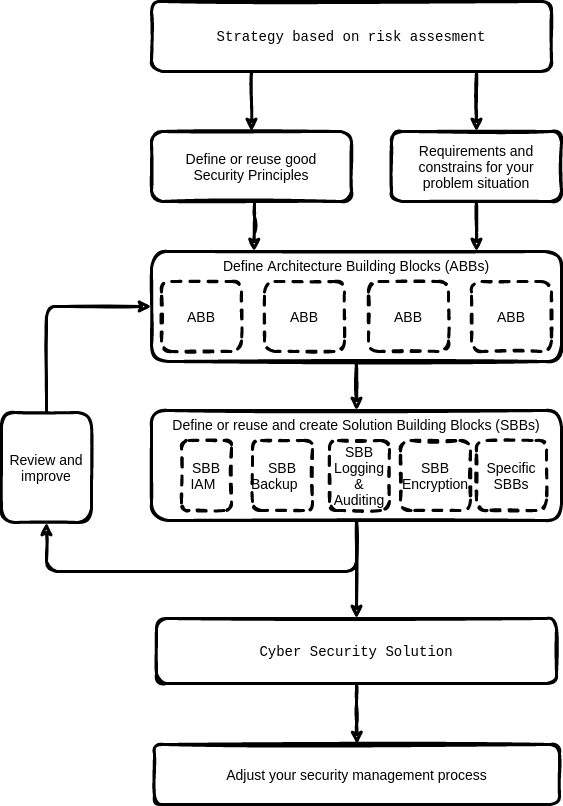
A security architecture serves the goal to move from abstract security requirements to concrete technical implementations, while staying within governance guardrails.
1. The “Why & Constraints”
Strategy, Requirements, Principles, Constraints, GDPR
These set the non-negotiable rules.Strategy – Business-aligned security goals.
Requirements – Functional & non-functional security needs.
Principles – E.g., least privilege, defense in depth.
Constraints – Budget, legacy systems, timeline.
GDPR is highlighted because privacy & data protection are mandatory (not optional) in many architectures.
2. Architecture Building Blocks (ABBs)
High-level, technology-agnostic capabilities
Common ABBs are:
Data – Classification, handling, lifecycle.
Logging – Event collection, monitoring.
Encryption – At rest, in transit, in use.
IAM – Identity, authentication, authorization.
Storage – Secure data persistence.
Auditing – Compliance and forensics readiness.
ABBs answer “what must the system do?” without specifying how.
3. Solution Building Blocks (SBBs)
Concrete, implementable technologies or patterns
Each ABB maps to one or more SBBs: Some example SBBs are:
ABB Encryption → SBB TLS, AES-256, KMS.
ABB IAM → SBB OIDC, OAuth2, LDAP, RBAC engine.
ABB Auditing → SBB OpenTelemetry + SIEM forwarder.
4. Outcome
(new) product / process / service
The entire flow delivers a secure-by-design asset, not just a checklist.
Key learning points
Never start with Solution Building Blocks (SBBs) – Avoid jumping straight to tools such as “we’ll use AWS KMS” without first establishing the underlying security rationale.
Always start with Architecture Building Blocks (ABBs) – Derive these from your security principles, requirements, and mandatory constraints such as GDPR.
Treat GDPR as an explicit constraint – It governs where data may be stored, how logs handle personally identifiable information (PII), and which ABBs and SBBs are permissible.
Steps for creating a security architecture using Security by Design practices
Define scope, goals and risk assessment
Establish the business context, assets, and high-level risk appetite.Determine (and actively elicit) requirements
Create a threat model (e.g., STRIDE, LINDDUN).
Apply a security model (e.g., Zero Trust, least privilege).
Use design principles (e.g., defence in depth, fail secure).
Define the required Architecture Building Blocks (ABBs)
Specify what the system must do in technology-agnostic terms.
Document your design decisions and rationale – this is critical for auditability and reuse.Identify the Solution Building Blocks (SBBs) that realise your ABBs
Map each ABB to concrete technologies, patterns, or products appropriate for your context.