
Why create a security architecture?
To prevent security disasters, you must develop a security architecture from the very start. However, creating one is not simple by default.
That said, creating a security architecture for a specific product does not have to be complex. Too often, security architectures drift from their essential goal: thinking in advance about measures to mitigate common security vulnerabilities. The result is long documents that are seldom read and useless for engineers.
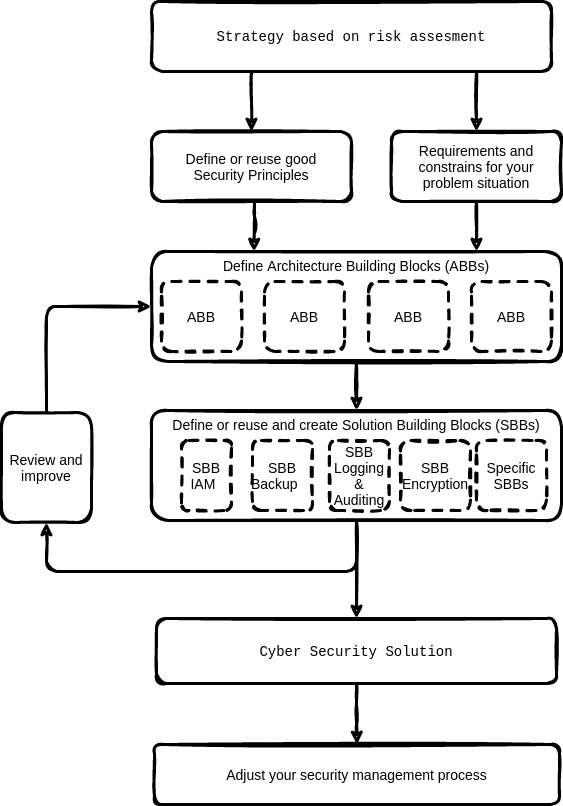
Steps for creating a security architecture using Security by Design practices
Creating a security or privacy solution architecture consists of at least the following steps:
1. Define scope, goals and risk assessment
Dive into the business strategy and organisation. Perform a simple risk assessment.
Establish the business context, assets, and high-level risk appetite.
Gather security principles and requirements relevant to your context.
Identify important constraints (e.g., time, budget, available subject matter experts).
Use a good reference architecture (external or internal) to maintain clear focus.
Use a risk-based approach. Without a discussion with responsible management on risks and possible mitigation costs, it is useless to proceed. Creating a threat model is vital.
Work principle‑based.
Determine constraints that apply to your architecture or design (e.g., time, budget, maintenance costs, expert availability).
2. Determine (and actively elicit) requirements
Create a threat model (e.g., STRIDE, LINDDUN).
Apply a security model (e.g., Zero Trust, least privilege).
Use design principles (e.g., defence in depth, fail secure).
3. Define the required Architecture Building Blocks (ABBs)
Specify what the system must do in technology-agnostic terms.
Document your design decisions and rationale – this is critical for auditability and reuse.
Derive ABBs from your architecture or design. ABBs help you scope your solution, clarify (new) integration aspects, and show where new solutions fit into the total IT landscape.
4. Identify the Solution Building Blocks (SBBs) that realise your ABBs
Map each ABB to concrete technologies, patterns, or products appropriate for your context.
Select (or create, or buy) the new SBBs. Prerequisites (functionality and technical constraints) must be clear and are often derived from the previous design step.
Speed up selection and evaluation of FOSS security solutions using this free guide.
5. Review and assess
Review and improve your solution. Use internal and external stakeholders, but also seek input from one or more external independent reviewers. An external reviewer has no internal interests and is solely focused on improving your security architecture.
If you need help finding an external reviewer, just ask for advice.